Thursday, April 08, 2021

Dandelions and sorrel

The dandelion season has begun again with one flower opening on a plant in Troy Track (where they get fairly well-trodden).


I have been looking at the many sorrel plants in the Green Sanctuary and last year's plants seem to have broken up into small-leaved clumps.  It will be interesting to see how they develop.


Tuesday, April 06, 2021

Diary April 2021

 At the beginning of April, I found a yew seedling close to the original birch tree in the Square Metre.  This puts the count of self-sown tree species up to 12.

It turned very cold from about the 4 April, which slowed things down a bit.  However, the first dandelion, one in Troy Track, came into flower on 6 April.

There are dozens of sycamore seedling this year.  When they first come up they can easily be spotted by the green gold colour of the underneath of the cotyledons.  As these fold outwards the upper sides are the most visible surfaces and they are a plain green that merges with the nearby vegetation.


The unfurling leaves of the second year sycamore seedlings are things of wonder with their rich coppery colour and intricate folding.


It turned very cold on the night of the 6th/7th with frost.  Many of the early flowering and leafing plants in the neighbourhood were scunnered by this and looked brown and miserable.  The cold wind continued all day on 7th and one worries about the birds, especially the insectivorous ones, as little or nothing appears to be on the wing.  However, things started to warm up on 8 April and temperatures look like returning to normal next week.

The 8th was a warmer day with the temperature rising to about 15 degrees.  A bee fly, Bombylius major flew by and settled briefly on the dandelion flower on Troy track..  There was one green bottle, Eudasyphora cyanella and a solitary speckled wood butterfly, the year's first.

I spent some time looking at the crumbling framework of Brambly Hedge.  What happens is that the floricanes bear fruit and die but, in the case of Brambly Hedge, they are not being replaced with primocanes for next years flowers and fruit.  So this leaves a tangle of pale brown thorny dead stems, with a few remnant leaves from last year.  It is not very beautiful to look at, but creates a wonderful protective cage for vulnerable plants that grow within it.  I also noticed that many of the old green bramble leaves are pock marked by something.  On most leaves as well as the pock marks, all on the upper side, there are brown patches which might be vacated leaf mines.  I suspect a Coleophorid moth may be the culprit.

On 10 April the temperature went up a little and there was some rain, though not enough to have much effect on the ground.  Despite the rather wintry weather it has been quite dry for several weeks.  By 11th the cold had returned with overnight frost, but things kept growing.  Hazel, sycamore and hawthorn are leafing well in the Square Metre and not far away flowers are coming out with the leaves on the tall wild cherry.  On 12th it was even colder with a light overnight frost and brief snow showers in the morning.  Growth is now slower than in most springs in The Green Sanctuary and some of the more tender plants around the garden are being scorched by the chill.

The weather continued cold, but with sunny days.  Very few insects though so it must be hard for the birds.  On 15th a single male green longhorn moth (Adela reamurella) landed on the grass just outside the eastern boundary of the Square Metre (see below) but otherwise there were very few of the usual April bees and butterflies.  

On 16th, as an additional experiment, I marked out a second Square Metre in Tana's old potato plot about 10 metres south of the existing Square Metre.  Tana dug it over last spring and the set and harvested potatoes, so it has stood as freshly turned earth over winter.  On 17th I listed all the plants already established in it.  I could identify: wood dock, creeping buttercup, red campion, sycamore (many seedlings) goosegrass dandelion, stinging nettle and dwarf comfrey.  A fine selection of weeds.  I think there was also some meadow buttercup, sowthistle and several grasses.


The site is open and sunny and I intend to keep most of the vegetation relatively short so that I an run over the square with a sweep net from time to time. 

Also on 17th I noted a small, dark insect which might be a bee or a sawfly on a rose leaf in the Green Sanctuary.  It spent some time carefully exploring some of the newly expanded rose  leaves and I am fairly certain it was getting something sweet.  There is certainly a dearth of nectar for these early flying insects. 


Over the next few days the weather changed to bright, sunny days and cold nights, but it was still generally cold for the time of year.  Insect numbers increased a bit with bee flies and mining bees on the wing, but butterflies are very scarce or absent.  However, on 20th April a red tailed bumblebee (Bombus lapidarius) landed in Brambly Hedge and rested for long enough for me to get a quick photo. 


The following day, after several yoga-like contortions I managed to get a somewhat blurry picture of a feathered leaf-cutter moth (Incurvaria masculella) resting on a hawthorn leaf in the Square Metre (the foodplant of this species is hawthorn).
 

It is now getting worryingly dry and one or two friends have remarked that bluebells to not seem to be flowering in such abundance as usual.  The forecast indicates many more days without rain and often with cold drying winds.

The drought continued, with more cold, bright days through 21st to 25th of the month (and maybe beyond as I am writing this on 25th).  Dust whirls in the lane when traffic passes, lawns are looking thirsty.  In The Green Sanctuary, I have noted a small ragwort plant, a species I thought I might have lost, both the eastern and the western dandelions are flowering intermittently and the wild service tree is shooting up well.  On 22nd I spotted a green shield bug climbing up the wild onion plants (see below).  This must be about the most difficult means of ascent in the area, but maybe the insect had its reasons.


The 24th was designated Cherry Blossom Day by the National Trust and I made a small contribution by photographing one of the fallen petals of the wild cherry that had blown into the GS (see below).  A few butterflies were out too and I saw a male orange tip and a female brimstone.


The ivy on the birch trunk is now starting to grow quite rapidly.  The leading leaves are almost black and quite shiny so that they look like small beetles.  A little bee with a distinct blue sheen was visiting the dandelions.  It might be a male blue mining bee (Osmia caerulescens) but I would have to catch and kill one to decide and I am reluctant to do that.  On 26th April the bugle spikes along Cynthia's Ridge were at their best and a speckled wood butterfly enjoyed the chilly sunshine, resting on leaves and bare earth.


It continued cold to the end of the month, with a shower or two of light rain on 30th.  The weather people say that there has been a frost somewhere on every night of the month.  Round about the spring countryside continued to unfurl with the hooded spikes of cuckoo pint, flowers on stitchwort, yellow archangel, hedge parsley and, of course woodsfull of bluebells and thick swags of blossom on wild cherry trees. Butterflies have been scarce but I saw the first large white on 27th.  The following day there were muscid flies resting on every stone and other surfaces in the Green Sanctuary.  I see singletons of this group of flies almost every day, but the sudden increase suggests a local emergence.
  

As a fitting end to the month I photographed the flower on the solitary new bluebell in Medlar wood.


Tuesday, March 30, 2021

Bluebell,daffodil & bee

 On the first really pleasant day of the year (21 degrees), I sat for some time in the Green Sanctuary and, as has been the case on this date sometimes in the past, it seemed unusually quiet.  There were however brimstone butterflies and bee flies enjoying the sunshine.  I keep thinking the garass is not growing as vigorously as it should and there are large areas of 'meadow' in the garden and M3 that are covered in moss, although bulbous plants such as daffodils, bluebells and colchicums seem to be growing more strongly than usual.  I haven't seen an worm casts in M3 whereas 16 years ago they were a fairly obvious feature.

Under the medlar tree I have discovered a bluebell.  Quite a large size so it must have been there for a year or two and an interesting addition to the plant list as it is associated with ancient woodland.

The small sallow bees, Andrena praecox, are about again.  They only sit very briefly on the birch trunk, but I caught the one below on a Tenby daffodil just behind the place I sit to study M3.


Wednesday, March 24, 2021

Trees and flies

 The picture below is taken from where I usually sit looking across the Green Sanctuary towards the north east.  Within this picture which covers an area about a square meter in extent, and including part of the original Square Metre, the following tree species, 12 in all, are growing, self-sown by wind, birds or animals: birch, oak, wild service, goat willow, holly, hornbeam, ash, hazel, hawthorn, wild privet, yew and sycamore.  There are two species of wild rose, ivy, bramble and spindle that has suckered in from the side.  There is a planted hedge of box and Lawson's cypress at the rear.


It is difficult to see all these species in the picture and I keep most of them reasonably small so that they don't take over.  However, it does show how woodland can regenerate from open grassland if nature is left alone to do the job for herself.

The mature birch tree towards the left is now regularly shedding storm blown unopened male catkins.


The sallow flies, Egle spp., that breed in sallow catkins have emerged.  The one below is settled on a dead oak leaf speckled with a microfungus that will eventually help with its breakdown and return to the earth.


Sunday, March 14, 2021

Cercospora leaf spot

Today I noticed that some leaves on the wild privet (Ligustrum vulgare) that grows, bird sown, in the north west corner of The Green Sanctuary had several leaves with brown ends.  The brown, dead part was differentiated from the rest of the leaf by a purplish semi circle and, on closer examination indoors, many spore-bearing pustules were seen on this band and across the rest of the underside of the leaf.


This is caused by cercospora leaf spot (Thedgonia ligustrina).  It is, I am sure, is quite common wherever privet grows in the British Isles, though it is rather seldom recorded. It does not appear to cause any great harm to the shrub apart from being, in gardeners' eyes, perhaps a little unsightly.  

Saturday, March 13, 2021

Another liverwort

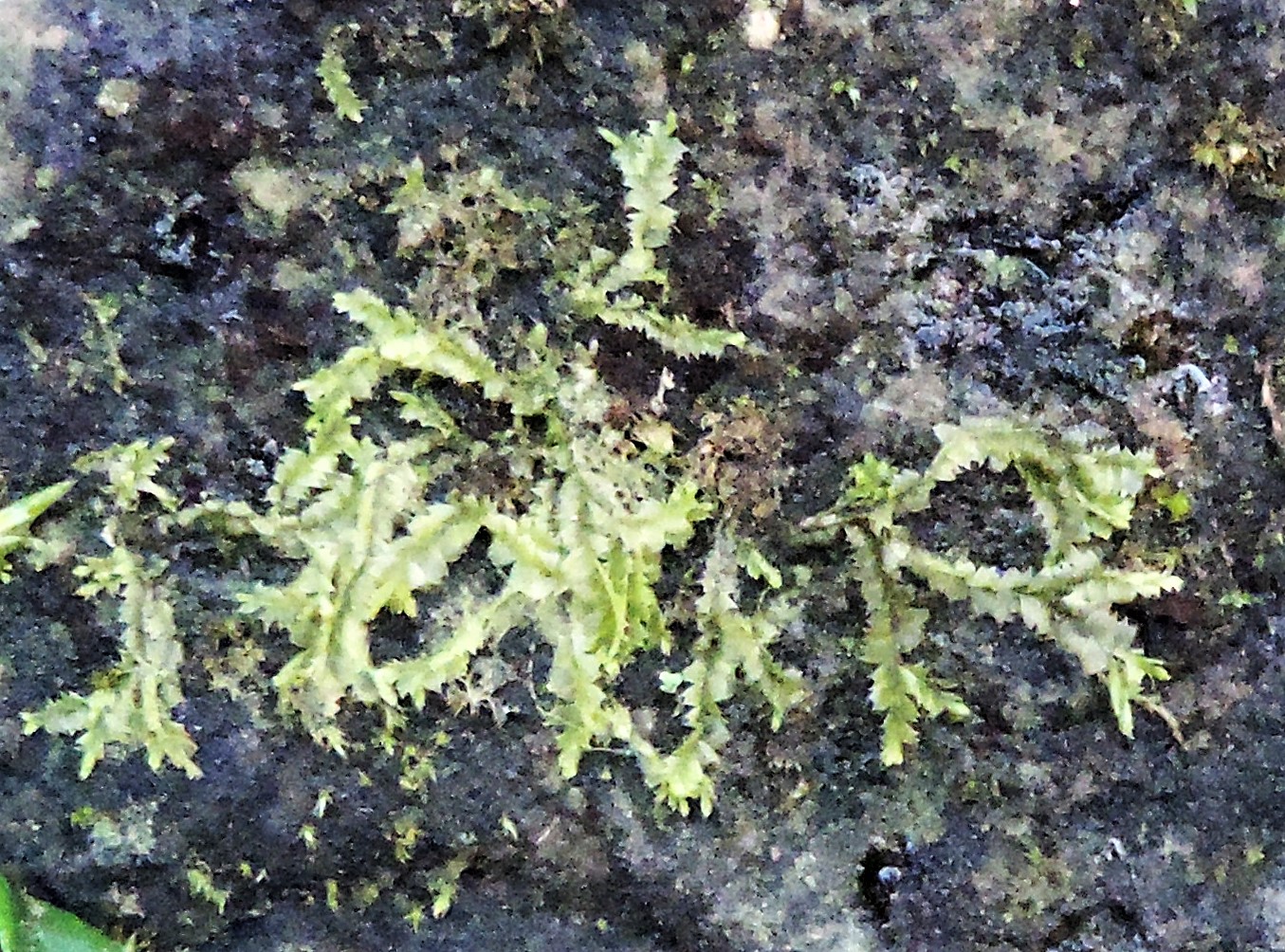
I was scrutinising the top of Butterfly Rock today when I noticed a small green patch different from the surrounding mosses.  On closer inspection it was clearly a liverwort, lower plants closely related to mosses but with a number of rather variable distinguishing features.  Once one is familiar with a few species it is quite easy to distinguish them from mosses.


My liverwort looks like bifid crestwort (Lophocolea bidentata) a very common and widespread species that grows both on wood and rocks though I have not seen one in the Green Sanctuary for 17 years.  It is one of several strongly aromatic liverworts and I wonder what the purpose of evolving scent was.  There are various insecst that live in and on liverworts, but the plants would hardly want to attract those creatures that are inclined to eat them..

Thursday, March 11, 2021

Birch and bumble bees

In windy weather such as we have had today, I always enjoy watching the large birch tree in the Square Metre as it rocks backwards and forwards.  As well as sap drips, unopened catkins have landed all over the ground beneath and the twigs that come down too seem to be quite fragile, though the tree in general seems to be scarcely damaged.  Around the bottom of  the trunk the ground moves as the tree sways and it is a marvel that the roots can hold the whole overground tree upright.  I don't know the volume of the birch but it must be at least a cubic ton.  The ground doesn't sink as this, or any other, tree grows, so I take it that virtually all its substance comes from the atmosphere.  The picture below shows the base of the trunk.  Note the climbing ivy showing a preference for the rough, dark bark.


Despite the wind the bumble bees were still active though two of them sought shelter among low vegetation for ten minutes or so before off foraging again.  The picture below shows a buff-tailed queen well tucked into ivy and red campion leaves at the base of the birch.


Tuesday, March 09, 2021

The cherry log

Turning a little warmer with some nice sunshine on my back.  The large birch tree was dripping sap again and I noticed that some of the Muscid flies including the greenbottle Eudasyphora cyanella and a Phaonia  species were seeking out splashed leaves and feeding from them.  As well as liquid, the birch sap must contain a variety of nutrients so feeding on the splash marks makes good sense at a time when other food sources might be few.


I have put an old cherry log near Pork Pie Pond, a place where I can easily keep an eye on it from my bench.  This is partly to see if any fungi or invertebrates patronise it, but also because birds will perch on it.  If it works like Butterfly Rock their droppings may contain seeds that wash down to the base of the log to flourish in the well-fertilised soil there.  In windy weather caterpillars may be blown down from the large birch and climb up the log which they have mistaken for the birch trunk. Looking on top of fence posts near tall trees in windy weather often presents interesting larvae.


Today I was inspecting the log with my close focus binoculars when I spotted two tiny (about 1mm) cream coloured blobs on one of the cut ends.  They might be the droppings of some passing insect  In the photograph above apart from the blobs there are some tine white spots in a roughly rectangular shape lower down and towards the right.  These might be sporophores of a slime mould or just random motes from the wind.  Taking close up photographs of wild bits and pieces often reveals things like this not easily seen with the naked eye.

The western dandelion is now accompanied by at least two others that were seedlings last year.  They grew slowly during summer and autumn but have speeded up during the colder months and may flower this year.  However, on my visit on 11 March I discovered that abut half the leaves had been eaten, possibly by rabbits or deer.  I think they will recover.

Monday, March 08, 2021

Spring advances. News from the Rock

Still cold but signs of spring continue to appear.  On some of the seedling hawthorns there are buds breaking with bright green leaves.  There is a scatter of recently germinated seedlings on patches of bare earth.  Birds, particularly blackbirds, peck over the fallen leaves and today had managed to bury the eastern dandelion completely.  The eastern dandelion is having to compete with a young lords-and-ladies (Arum maculatum) which is, not surprisingly, larger than it was last year.  The birch tree continues to drip sap creating small splash sounds easily heard in these quiet days of Covid lockdown (though the children have gone back to school today, putting more traffic on the roads.


Butterfly Rock still continues to deliver interest.  The picture above shows that grass and sorrel is surviving among the moss on top of the rock while the pale green patch close to the centre is a lichen, possibly a Bacidia but I shall have to let it develop a bit.


Thursday, March 04, 2021

A cold March day

One of the things I enjoy least are cold spells in spring.  With the arrival of February some days of warmth happen.  Primroses, crocuses and daffodils flower, snowdrops are fading.  Then - bang! – the wind turns round to the north and a huge cloud-hung blanket of arctic air descends from the Polar Vortex or some other extreme weather circumstance at the top of the world.  Venturing forth in such conditions means the heaviest of clothes, fully drawn down hats and fingers frozen in the wind or from touching cold surfaces.  Precocious plants wilt, frost stricken and the black branches of winter trees rattle their twigs in the icy blast.  As one’s spirit sinks, the thought slinks into the brain that this might last for many weeks: March will go by, April get started and weather forecasts will still talk of late frosts and warn that “it is turning colder”. 

With these grey thoughts I walked down to The Square Metre in my slippers and gazed glumly at the winter flattened grass and leafless trees and shrubs with unbelief that the great summer resurgence is only a few weeks away.  But in my mind the chill was mitigated and the grey thoughts dimmed by the knowledge that the sunshine will come back with added strength, growth will resume and my spirits will return to a more acceptable place.

Wednesday, March 03, 2021

3 March 2021

Rather cold (9 degrees at midday) and with a thin mist everywhere.  I only made a quick visit to Emthree, but rediscovered the wild privet in Medlar Wood though it is well hidden in a tangle of tutsan and brambles.  The second privet is also doing well in the north east corner of the area but neither plant grows very quickly.

Looking back through past entries in early March, I noted that rabbits used to eat the pendulous sedge plant in Medlar Wood.  It does not seem to have suffered that fate this year, though it woulkd grow better if it had a little more light.

Monday, March 01, 2021

Lichens on twigs.

Today I spotted a small tuft of oakmoss, Evernia prunastri, one of the commonest and more easily identified lichens on a slender twig of the birch that I could just about reach.  Oakmoss is important in perfumery and has a large range of other uses.  One of its distinctive features is that the branches are paler underneath than on the upper side.


On looking at it under the microscope I noticed a much smaller greenish granular species dotted with dark fruit bodies.  It ran down to Fuscidea lightfootii in all my sources of information.  There were two further species on the small piece of twig I brought indoors: one with a very thin, greyish thallus and very few fruit bodies and another dark brown, very visceral-looking species that might be a Melanelixia.  The twigs were also heavily dusted with a green alga, probably a Desmococcus species.

The day after I discovered some beautifully patterned lichens on the smooth bark of the still standing pole of the dead ash.  These were readily identifiable as Arthonia radiata, another widespread species.  There was a second species with a very thin, grey and formless thallus scattered with rather few fruit bodies that will need further work to attempt an identification.  A good place to start with these is the Natural History Museum's publication Key to lichens on twigs.  This is also an online key A Key to Common Lichens on Twigs in the Key to Nature series:  https://tinyurl.com/2rzkjj53


Spring dandelions

My dandelions seemed to have disappeared during the winter.  Perhaps just covered in leaves, though they also lost there late summer leaves.  The more easterly of the two now has several healthy, but unusually narrow, leaves spread starfish-like on the ground. It looks as though some animal has had a nibble at the centre of the crown.


The westerly dandelion looks a little more tattered and there are three or four younger plants still further west.


Commentary 1st & 2nd March 2021

1 March 2021, St David's Day

Some oak leaves buckle as they dry in the sun, making a small clicking sound.

Sap is rising and there were glistening caps of liquid on the coppiced twig ends of the hornbeam cordon. Sap also fell from the birch in occasional drops and the twigs would bleed if cut.

Deep purple twigs that have blown down in winter storms are lying all over the Green Sanctuary - almost a protective net.

Yesterday I saw a small bird (chiff chaff or willow warbler) ferreting around the area. Maybe a new arrival or an overwintered bird.  It seemed particularly interested in the box bush.  Today I saw a wren and a robin while there were two hedge sparrows playing catch-me-if-you-can in the medlar.

Also yesterday I scraped some of the black patch that covers Butterfly Rock where it is bare of moss. I could discern no particular structure when I looked at it down the microscope later and it maybe that the sandstone itself turns black naturally if kept moist much of the time.  I have put it in on damp blotting paper in a small plastic container to see if it 'develops' in any way.


The wild onion bulbs have mostly divided underground and have produced many thin, sea green 'chives' over the last few weeks..  'Is there such a thing as a chive I wondered and in modern culture there is a verb 'to chive', e.g. Keep Calm and Chive On (KCCO). 'Chive on' seems to be a bit like 'rock on'.

I started to look at lichens..

Sunday, February 28, 2021

Winterreise

Cold spot

The cold weather from the east brought frost and snow to the Square Metre in mid-February but most of the snow had gone by 14th or 15th of the month.


A small amount remained at the base of the north side of the birch tree, that part of the Square Metre the sun cannot not reach.  Generally the quadrat is warm and sunny, but this area at the back of the birch must have a relatively cool and moist microclimate.

Smeuses

A short distance to the north east is the entrance to an animal's route through the bushes from our neighbour's garden (see below). Such features of the countryside are, or were, known as 'smeuses'.  It has been suggested that the word 'smeuse' is a corruption of 'meuse'. This is thought by etymologists to derive from Middle French 'muce' meaning a hiding place and was in widespread use in England in mediaeval times. It seems to have nothing to do with the river Meuse.  The s prefix could come simply by running one word into another, e.g. 'it's a badgersmeuse.


Saturday, February 27, 2021

Last year's comma

Last August  I was examining the sallow cordon (Salix cinerea) that has been growing in the south west corner of the Square Metre for many years when I spotted a strange brown creature on one of the leaves.  To begin with I couldn't work out what it was.


After looking at various books I worked out that it was a full grown larva of a comma butterfly (Polygonia c-album) a species that is quite common around the garden and whose larvae I have occasionally found on stinging nettles.  While nettle is the usual foodplant, the caterpillars have been recorded from sallow.  In our garden there is plenty of both these plants and it is interesting that sallow was chosen by the egg-laying female.

Birds are known to eat comma larvae and as a defence against predation, especially in their earlier stages, they are said to look like bird droppings. In the photograph above the caterpillar is clearly adopting a threat position with its hinder end raised and  its penultimate pair of legs imitating short arms.  The head, perhaps the most vulnerable part, is kept well down on the right.  Also the body is twisted well out of normal caterpillar position to give the impression of a large bird dropping.  If, when startled, the caterpillar adopted this position rapidly the sudden movement, combined with the other factors, might be enough be deter a hungry bird.

Despite searching online and in my books, I can find no reference to this kind of distinctive behaviour in comma caterpillars.

Friday, February 26, 2021

Plum Blossom Day

The 25th February is celebrated as Plum Blossom Day in many parts of Japan and, right on cue, a few delicate white flowers have appeared on the scrubby cherry plum bushes in our garden not far from the Square Metre.

As well as bringing on early flowers, the warm weather is encouraging insects to appear.  A seven-spot ladybird was sunning itself in Brambly Hedge and several bumble bees zoomed  through the Square Metre air space.  One settled among the dead leaves and ivy and remained there once it was well tucked in.  It looked too small for a queen (most early flying bumble bees are queens) and I suspect it was a worker that had managed to overwinter.


 The hiding bumble bee is in the centre of the lower picture.

Vegetation is still mostly at a standstill apart from goosegrass (Galium aparine) whose autumn germinated plants seem to grow in a cheery fresh and green manner whatever the weather.  Goosegrass is one of many English names for the plant and geese are reputed to enjoy eating it.  Perhaps it supplies some welcome fresh green stuff for them in winter.  One baffling name (to me ) for the plant is the Welsh lau'r offeiriad which means 'louse of the priest'.  I would welcome an explanation.


Wednesday, February 24, 2021

Franchet's cotoneaster

Several small cotoneasters have appeared in Medlar Wood over the years, the seeds, no doubt, occurring in droppings from the branches overhead.  Last year one of the largest produced flowers and fruit and, using all the botanical resources I could, find it appears to be Cotoneaster franchetii, Franchet's cotoneaster.  My plant shed its leaves quite rapidly in autumn and C. franchetii is said to be evergreen or semi-evergreen.  The leaves also turned a quite vivid red.  The indicates it could be var. sternianus introduced from Myanmar in 1919, a variety sometimes misnamed as C. wardii.  It has been given an Award of Garden Merit (AGM) by the Royal Horticultural Society.


The summer fruits (below) and the flowers agreed closely with descriptions of C. franchetii.  

The shrub's specific name commemorates the 19th century French botanist Adrien René Franchet.  There appears to be no English equivalent for 'cotoneaster' which is from Latin meaning quince-like.  I think Franchet's false-quince would be a nicer name, but I don't suppose it will catch on.


Tuesday, February 23, 2021

Early spring 2021

Now winter seems to have passed and we are getting some sunny February days.  The corona virus pandemic seems to be receding too, so spirits are rising.  Today I re-found the two older dandelion plants I spent so much time enjoying last year. They have been hidden under fallen leaves and worm casts for months.  They are currently quite small with very narrow leaves, each from a single rosette, but they look healthy enough.


I have a view down the garden from my new position at the desktop on the table.  The 18-year-old birch tree that grows in the south west corner of the Square Metre is tall enough to see it from my room.  The picture above shows it behind one of our juniper bushes during the recent cold and snowy weather.

Ivy is starting to climb the lower part of the trunk of the birch and, I suppose, will one day overwhelm it. The ivy leaders all start on the rough black bark and mostly remain on this as high as it goes when they move on to the much smoother white bark.  They seem to be able to cling tightly to either substrate without any difficulty and it makes me wonder, if it is not coincidence, how the ivy selects the black rather than the white.  


Sunday, July 19, 2020

Horse flies and feathers

The other day I found a feather on the ground in the Square Metre


.It is a pigeon’s feather and a complex structure with four different shades of grey.  There is a broad white streak along the leading edge and a much finer white one along the tailing edge.  The central quill is blackand contrasts strongly with the grey on either side.

I have pushed the quill end into the ground by the self-heal near my feet where I sit and I intend to watch its deterioration (or disappearance).   I have a book somewhere which includes details of microfungi that grow on feathers.  So far I have not been able to find any of these so perhaps my pigeon's feather will fill this gap.

Although insects are rather few at the moment, the list continues to grow and the other day I photographed this horse fly (Tabanus bromius I think) resting on a leaf in Brambly Hedge.