Sunday, March 01, 2009

Budding hawthorn

A couple of days ago when I was looking for rabbit damage I noticed that the hawthorn (Crataegus monogyna) seedling in Medlar Wood was already showing green and ready to burst.

20090227 South View & Metre 017

This is several weeks ahead of normal bud break time despite the fact that it has been a fairly cold winter.

However, I am sure this is not global warming.  Maybe young plants for some reason come into leaf earlier, though I cannot see how this could be an advantage.  It would seem to make them more vulnerable to hungry browsers and late frosts.

Tuesday, February 03, 2009

A cold winter

Yesterday there was some of the heaviest snow for several years and it persisted today, though with intermittent thaws. It did not seem to have covered Emthree to a remarkable depth and was melting quite quickly when I visited.

20090203 Metre snow 011

However, this is said to be the coldest winter for many years and it will be interesting to see if there are any manifestations later in the year that might be attributable to this.

Sunday, January 25, 2009

Dung cannons (Pilobolus crystallinus)

I put some of the rabbit pellets in a damp box and they have developed a fine vestiture of the dung cannon fungus (Pilobolus crystallinus).

25012009 Pilobolus crystallinus 005

There is a much better picture here.

This humble microfungus must be one of the world's most remarkable plants.  The little black spore capsules on the top of each thread-like, crystalline stalk can be fired for up to 2 metres and can accelerate from 0 to 45 mph in the first millimetre of flight - apparently the second fastest accelerator in nature.  The pressure in the stalk below the capsule can build up to an astonishing 7 kilograms per square centimetre (100 pounds per square inch) to enable this.

Pilobolus is also the name of a celebrated American dance company (one of the founding members studied the fungus with his father when he was young). They are an amazing group as their web site www.pilobolus.com shows and somewhat more elegant than my crop of fungi on rabbit dung.

I feel quite pleased, however, that close scrutiny of a rabbit dung pellet has opened such interesting doors.

Sunday, January 18, 2009

Some winter finds

Now the weather is milder it is easier to do some work in Emthree and yesterday I started to clear back some of the long and untidy grass that has been blanketing the ground since last autumn.  Underneath it is thick with moss and I discovered some tubers on the base of one of the stems of common figwort (Scrophularia nodosa).

20090117 Metre figwort root nodules 009

The ones lower down the stalk had been attacked by a white mould or mildew and looked dead, but the smaller upper pair were still in good shape.

These tubers (which are perfectly normal structures rather than galls caused by an external agent) were much used in the past against conditions like scrofula (hence the scientific name Scrophularia) and hydrophobia.  In the latter case it was recommended that the dried tubers were powdered and sprinkled on bread and butter after which one was supposed to take a long and energetic walk wearing far to many clothes for comfort.

Another discovery was a scatter of rabbit droppings along the mossy top of the yew log on the edge of Medlar Wood.  Positive evidence that they are still active in Emthree.

20090117 Metre rabbit droppings 001

Sunday, December 28, 2008

Varied seed heads

Now the coldest winter here for several years and today with hard frost.

Everything in Emthree is brown and silent, clamped in winter's icy vice.  I expect the consequences next spring and summer will be better than if we had had a mild winter though.

20081225 Metre 004

20081225 Metre 002Dead stems and seed heads provide some interest and it is useful, say, to learn what perforate St. John's wort (top above) or common figwort (lower above) look like in fruit.

Thursday, December 25, 2008

Christmas surprise

On a quick visit on a sunny Christmas Day I was pleased and surprised to find several groups of the shining ink cap (Coprinus micaceus).

20081225 Metre 007

Although it often comes up in grassy places it is a species that grows on decaying, often buried, wood.

The species is sometimes said to be edible and is not poisonous as such.  Like other members of the genus it does, however, have an adverse effect if eaten in combination with alcohol and is therefore best avoided.  It is small and hardly worth it anyway.

Sunday, December 21, 2008

Midwinter's Day

The shortest day brought a fine, sunny afternoon, but the Square Metre looked drab and tangled after a quite long period of frost and wet.

20081221 Metre Iris foetidissima One of the most striking objects was a fan of leaves made by a plant of stinking iris (Iris foetidissima) growing under the medlar tree.  After flowering they produce red berries which, clearly, are eaten by birds who later void the seeds.  We have three plants in the study area that have originated in this way, but you have to be able to see a youngish plant flat on to get this pandanus-like effect.

Tuesday, November 11, 2008

Stinging nettle midges

Better weather but rather cold and soggy underfoot. There is an animal track of pressed grass across Emthree from the south east corner to Midsummer Pond, quite clear now I have let the grass grow longer.

Today I took some of the bamboo canes from higher up the garden that have died after flowering and used them to make short palisades round the heathers and various young trees and shrubs that may be vulnerable to rabbits and even deer.

The upper part of each cane has twiggy outgrowths and these provide additional protection. Anyway, we’ll see how it works. I also put a single cane up against the young ash tree by Ash Edge as this might deter rabbit attack too.

20081111 Metre Dasineura urticae 001

While ferreting about in Medlar Wood, I found one of the retained nettle plants heavily infested with galls caused by the midge Dasineura urticae – a new record for the project.

Tuesday, September 16, 2008

The Square Metre's fifth birthday

15 September 2008.  The project is five years old today.  It is a warm September morning.  There are purple knapweeds, yellow hawksbeards and St John's-worts, also yellow, in flower.  There is a late greater bird's-foot trefoil, a few purple self-heal and the cerise cockade of Cornish heath.

20080915 Metre 015 Various flies visit the flowers, bending and shaking the stalks. A cranefly (Tipula paludosa) bumbles about in my mini-Malaise trap.

The project area seems crowded now because of all the things I want to keep and so different from the first photo I took (below) just after initial clearance.

20030918 Metre In the other world 15 September 2008 was a dark day on the global finance front.  The major American investment bank Lehman Brothers filed for bankruptcy and there were many other manifestations of what the media frequently call 'global financial meltdown'.   I am sure we will be affected in one way or another but, hopefully, I will have another five years watching my square metre.

16 September 2008.  A cool, evenly grey day withy the temperature hovering continuously at around 60 degrees F.  There is a cluster of common bonnet toadstools(Mycena galericulata) with caps the colour of the clouds on the old log by Troy Track where the lizard used to sit.

20080915 Metre Mycena galericulata  007 On the last of the bramble flowers there were sleepy wrinkled ants (Myrmica ruginodis) searching for nectar and pollen and transmitting messages with much waving and mutual stroking of their antennae.

Planet Terracotta is dry again and there are now several moss species among the bittercress and grass seedlings - something for me to identify in winter.

My mini-Malaise trap is still not being very successful and today caught nothing.  There are very few insects about, but I was pleased to a see a fine hoverfly, Rhingia rostrata, on my late-flowering knapweeds.

Monday, August 18, 2008

A birch bolete (Leccinum scabrum)

20080818 Square Metre Leccinum scabrum 058

The appearance of a birch bolete by the western edge of the square metre was quite a surprise.  It was the largest of the fungi so far recorded and, as it is quite close to the birch tree on Thistle Moor, it would seem that it has had time to form a mycorrhizal association with the tree roots and produce a fruiting body.

20080818 Square Metre Leccinum scabrum 060 The birch tree only appeared as a seedling in 2004 and is  now maybe four metres tall.  It has already been host to several microfungi, leafminers, sawfly larvae and other flora and fauna and is a good illustration of how one plant can support a whole community of biodiversity.

This in turn should boost the invertebrate count with beetles and flies associated with larger fungi of this kind.

Sunday, July 27, 2008

Hoary willowherb flowers

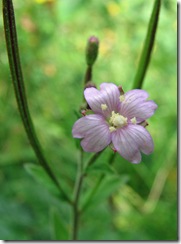
Today the first flowers appeared on the hoary willowherb (Epilobium parviflorum) that arrived this spring.

One of my books says this is a plant "preferring damp places on limy soils" however, it is growing in a dry place on acid soil in the Metre.  It looks quite healthy, but is small for its species.20080727 Metre Epiliobium parviflorum 004

With broad-leaved, square-stemmed, American and rosebay, we now have four willowherbs in the project area and all are in flower.  I will have to look for hybrids as this is a very promiscuous genus.

Sunday, June 29, 2008

White admiral butterfly, Limenitis camilla

20060731 Limenitis camilla Eupatorium Darwell Wood 4a

The highlight of today was the appearance of a white admiral butterfly in Emthree.

I think there is one butterfly in the garden and I saw it first yesterday from the windows of our house as it flew round the back door.  Today I saw it again several times, mostly at bramble flowers.  Then, as I was heading to feed the tortoise, it rose up from Emthree and circled round briefly before soaring majestically over the hedge.

I was not able to get a photo, but the one above shows a rather worn example in a local wood nectaring on hemp agrimony.

Saturday, June 07, 2008

Early June update

 20080605 Various 028

20080606 Metre Potentilla reptans 003

18 May 2008  7.30pm and the sunlight filters through from the north west. It is quite cold.

I have weeded the heather area.

A flower is about to open on one of the three plants of cut-leaved cranesbill (Geranium dissectum) in Submespilus Assart.

Tops have been nipped from one of the rosebays and the perforate St Johnswort. This can only have been done by deer, though I could not find any footprints.

19 May 2008  The figwort has started flowering now. The one behind Bittercress Moor is almost as tall as I am.

A centaury plant seems to be making it to the north west of Midsummer Pond. Not the sunniest place in the project, but bare ground which this plant likes. This is the first I have seen in Emthree since October 2006.

The smooth-rush wands have been rather pushed over towards the pond, maybe just an effect of wind.

It is clear and cold.

20 May 2008 Everything is growing with great speed and vigour – I need to spend time, lots of time at Emthree but I think it will be okay for a while during my busy period.

Petals are falling from the medlar on to Mespilus Assart and Planet Terracotta – small white hearts.

21 May 2008  I have at last done some serious labouring. I tied back the brambles and physically pushed them into North Wall and the box bush where the thorns have, for the moment, held them fast.

I have also lightened up the heather and hornbeam in The Waste and on Bittercress Heath. Despite the volume of arisings I have removed in the last four and a half years, I am sure the land is more fertile that when I began the project and things can be smothered rapidly at this fast-growth time of year.

Heath speedwell (Veronica officinalis) is in flower now and pink is showing on the bud on the campion in The Waste. I have found new shoots on the gipsywort, now in its third season and seemingly not minding in the least that it is not growing in a wetland. The only plants struggling a bit are the square-stalked St Johnsworts (which appear, once again to be suffering some sort of fungal attack on the leaves, distorting them and somewhat stunting the growth) and a ragwort that has keeled over.

Mosquitoes, Anopheles plumbeus, are everywhere and biting well if they get the chance.

22 May 2008 I bought some new shears and have been keeping Bramble Hedge and other unruly spots in order.

The red campion is now fully out: later than larger plants but determined to make it.

The soft-rush (Juncus effusus) has produced many of its brown flower burrs three quarters of the way up its stems and I wonder if any of the little Coleophora moth caterpillars will make their cases among them.

Creeping buttercups are putting up a respectable show of flower for the first time since this project began. In the past they have been rather shy flowering.

23 May 2008 The central leaves in the cat’s ear rosettes look as though they have been frosted because of the dense white hairs and I am not sure they are entirely healthy. The flower buds on their long green stalks seem fine though.

24 May 2008 Search as I might I cannot find any smooth tare plants in Emthree whereas in previous years they have been quite a feature in their modest way.

During the night there was heavy, pond-filling rain and Planet Terracotta has its lake again. I wish it was a turlough: such a nice word.

27 May 2008 More rain: some places have had one and a half times more than the average for the whole month of May.

Planet Terracotta is full of water to the brim and it is too wet and cool to feel enthusiastic about doing anything.

One of the cat’s ear buds is showing yellow, so it really is quite an early plant to flower.

28 May 2008 Still trapped by work. I wandered down the jungle-wet garden to feed the tortoise and have a quick look at Emthree.

The rain had borne the sorrel stalks over in great green and pink loops so that their heads touched the ground. All lay in the same direction like worshippers of the rain gods. I was reminded of the piece of music ‘Shaker Loops’.

31 May 2008 Still warm, wet and growing. Two wonderful cat’s-ear flowers out today and more flowers on the campion in The Waste.

Rough meadow grass (Poa trivialis) is coming into its own now.

A queen carder bee likes the common figwort flowers and a queen hornet zooms across from time to time.

1 June 2008 Today I gave Submespilus Assart South its monthly cut with scissors. It had grown a lot since the beginning of May and a surprising number of plants bore flowers: creeping buttercup, wavy bittercress, herb-robert, annual meadow grass.

2 June 2008 A visit to take the first day of the month photos I forgot yesterday.

The wildness and wet continues and Emthree is a jungle.  11th June (haymaking) will be, I keep telling myself, the day of reckoning.

4 June 2008 At last I have a little time. Emthree is having a big summer and I have had to make some serious inroads into the burgeon.

I hand grazed the western arm of Troy Track from Midsummer Pond to my seat. I tied up the knapweed on the north west corner of the Metre and the wild rose with it with it as disentanglement seemed likely to be difficult.

The large black bryony is not doing well this year. There are only two or three climbing shoots and the leaves are sparse with an unhealthy yellowish tinge.

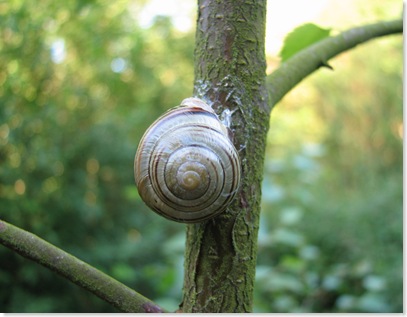
The first bramble flowers are out and I found a white-lipped snail nearly 2 metres up the Thistle Moor birch. The hoverfly Meliscaeva auricollis was seeking nectar and pollen on the cat’s-ear flowers.

6 June 2008 A second cat’s ear is flowering. As tall-stalked dandelions they are very beautiful flowers.

The first ever creeping cinquefoil (Potentilla reptans) flowers have appeared in The Waste. The plant was first seen in Bittercress Heath in October 2006. It then sent one or more runners along Hazel Edge and the these first flowers have opened in Great Plantain Desert, over one metre from its original site.

7 June 2008 I trimmed the bramble hedge dividing Emthree from The Meadow this evening. It is developing very well and is almost as good as any hedge now. The brambles are flowering and rushes are poking through at the western end. There is male fern too in several places giving a variety to the texture and there are also knapweed, hogweed, cock’s-foot and nettles growing up through.

I wonder how it will develop and suspect that woody plants will eventually take over.

Thursday, May 22, 2008

Mid-May update

20080522 Metre Ranunculus repens 004 

16 May 2008 The smaller birch has many wiggly leaf mines but the larger tree does not seem to be similarly affected.

The black bryony is now about one metre up its pole.

18 May 2008 7.30pm and the sunlight filters through from the north west. It is quite cold.

I have weeded the heather area.

A flower is about to open on one of the three plants of cut-leaved cranesbill (Geranium dissectum) in Submespilus Assart.

Tops have been nipped from one of the rosebays and the perforate St Johnswort. This can only have been done by deer, though I could not find any footprints.

21 May 2008 I have at last done some serious labouring. I tied back the brambles and physically pushed them into North Wall and the box bush where the thorns have, for the moment, held them fast.

I have also lightened up the heather and hornbeam in The Waste and on Bittercress Heath. Despite the volume of arisings I have removed in the last four and a half years, I am sure the land is more fertile that when I began the project and things can be smothered rapidly at this fast-growth time of year.

Heath speedwell (Veronica officinalis) is in flower now and pink is showing on the bud on the campion flower in The Waste. I have found new shoots on the gipsywort, now in its third season and seemingly not minding in the least that it is not growing in a wetland. The only plants struggling a bit are the square-stalked St Johnsworts which appear, once again to be suffering some sort of fungal attack on the leaves, distorting them and somewhat stunting the growth, and a ragwort that has keeled over.

Mosquitoes, Anopheles plumbeus, are everywhere and biting well if they get the chance.

22 May 2008 I bought some new shears and have been keeping Bramble Hedge and other unruly spots in order.

The red campion is now fully out: later than larger plants but determined to make it.

The soft-rush (Juncus effusus) has produced many of its brown flower burrs three quarters of the way up its stems and I wonder if any of the little Coleophora moth caterpillars will make their cases among them.

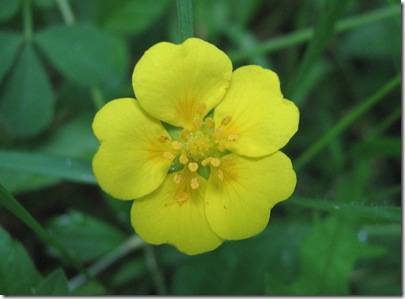
Creeping buttercups (see picture above) are putting up a respectable show of flower for the first time since this project began. In the past they have been rather shy flowering.

Sunday, May 11, 2008

Darkness all day

20080507 South View blackbird in tdead tree 

The first herb-robert flower is out – a white one as they all are in the garden. The medlar is flowering too, though there are still many unopened buds.

The Waste, Mice & Red and Volepasture are all grass stalk verticals like torrential green rain.

A queen hornet plunged into the grass behind Bramble Hedge.

In the hottest part of the day a moth flew round the Waste and the Square Metre.  I am pretty certain it was a small yellow underwing (Panemeria tenebrata) and, as the larvae feed on mouse-ear chickweed, there is plenty to attract it to Emthree.

This small yellow underwing has a wonderful scientific name, especially the 'tenebrata' part.  This is a word that reverberates like rasgueado played on a theorbo.  Our English equivalents like 'dark' and 'shadowy' have a soft sound recalling the oblivion of night, sleep or death, but 'tenebrata' gives simple blackness a complex, vibrant energy like that of the dark matter that pervades the universe (so they say). Use of this word makes darkness seem far from deadness; it denotes a living darkness full of mysterious sound and movement.

The generic name, Panemeria, means 'all day long' so Panemeria tenebrata can signify darkness all day, an apocalyptic vision encrypted in this small moth whose future, like that of so many invertebrates, is far from secure.

As St Augustine said quae peccato tenebrata non est (which sin is not dark) and I am sure he would have called trashing the planet a sin.

I know the real reason for the generic name is that the moth is day-flying and that  'tenebrata' refers to the dark shading of the forewings.  Nevertheless ....

Saturday, May 03, 2008

May Day + 1


Really a quite flowery scene today. The forget-me-nots are at their best and there are about a dozen spikes of bugle, now well distributed from their original 2004 beachhead by Purbeck Slab. The photo shows those next to the fox poo - beauty and the beast.

In the yellow department there are some creeping buttercup and dandelion flowers, though the latter shut towards evening.

The sorrel stems are beginning to up-wind rapidly now and sweet vernal grass continues to advance towards anthesis.

It is amazing how quickly small plants can be overpowered during this May growth surge and I like watching the cat’s-ear rosettes flattening the surrounding vegetation like greedy green wide-armed starfish.

As it is the beginning of May I made the first cut of Submespilus Assart South, initially with scissors, then by hand-grazing. It reminded me of a remark on lawns by Timothy Morton in Ecology without Nature: “They are just a horizontal, mass-produced version of the wildernesses people visit to find peace and quiet and a sense of abstract nature.” He had previously written that “Wilderness can only exist as a reserve of unexploited capital.” Thus a lawn, as a kind of Mortonian wilderness, is a reserve of unexploited capital as the developers who are building houses on the lawns in people’s large back gardens have realised.

Tuesday, April 29, 2008

Metre as a mind mirror

I have read that some prefer to describe things from life, at the scene, while others like to recollect and write later, when back at home after am event.

Today I am doing the latter, recalling the choir of pink and blue forget-me-not flowers, the yellow of the dandelions, the violet-blue bugle pagodas and the white tipped sprays of bittercress.  In Medlar wood there is the drooping purple green hood of a wild arum (or cuckoopint).

As Timothy Morton (2007) says "Some nature writers think that they are receiving a direct transmission from nature, when in fact they are watching a mirror of the mind."

Morton, T. (2007)  Ecology without Nature.  Rethinking Environmental Aesthetics.  Harvard University Press, Cambridge Massachusetts and London, England

Monday, April 28, 2008

April notes

22 April 2008. There is a flower on a third dandelion plant now.

There are many wrinkled ants running about on the Lyon Stone and they appear to be building an earth particle nest in front of it, something I have not observed them doing before.

24 April 2008. Everything is doing well as the season advances. Springwatch (BBC TV) rang up today and want to re-show last year's session at Emthree and take the window box to Bill Oddie's garden in London.

Spikes of sweet vernal grass are starting to appear and are moving towards anthesis very quickly. The red campion in Submespilus Assart South has one, two, three four open flowers.

I am still struggling with the male ferns (Dryopteris spp.) and need to do more work on distinguishing D. filix-mas from D. affinis - all the fern books seem very misleading.

There are several tiny, self-sown forget-me-nots in flower a short distance from the original plant and I wonder why they are so small compared with their parent: not fertilised by snail juice and bird poo washing over the edge of Butterfly Rock maybe.

25 April 2008. Every day Emthree gets greener and greener and more grassy looking.

I have rediscovered the fleabane plant, but its first leaves are quite a long way from where they were last year, having travelled to the north east of Onelitre Pond, whereas last year it grew to the south of this water body.

The third year bramble - primocane, floricane 1, floricane 2 - will flower soon, well ahead of last year's floricanes.

Midsummer Pond is full of mosquito larvae and the wrinkled ants are ferreting about on Lyon Rock again.

26 April 2008. A lovely spring day. The creeping buttercup on Submespilus Assart North has an opened flower and a dandelion, mirabile dictu, is blooming in a very shady spot on the north side of Medlar Wood demonstrating how at least some dandelion microspecies will grow successfully in low light conditions.

Ants were hustling about on Lyon Rock again, but as soon as I come on the scene they disappear. They are definitely interested in the fox's poo, but just clamber about on it like mountaineers rather than searching for something to eat.

The red campion in The Waste is sending up what looks very much like a flowering stem. There seem to be two forms of this plant: one that is fairly bushy and another, often paler green, that sends up solitary, upright flowering shoots.

I think my tiny, rabbit-bitten holly seedling in The Waste going to survive as it has produced some tiny, toffee-green blimps, new buds near the shoot tip.

28 April 2008. I am beginning to believe we have only one scaly male firm, at the western end of Medlar Wood. The other three have much less of a golden cast as they unfrond and are probably Dryopteris filix-mas. But if so the books are wildly wrong.

I pinched off one of the shoot tips of the perforate St John's wort today as the plant is supposed to contain red juice called, in Germany, Balder's blood. It does not have red juice, only the normal, greenish sap. However, I did find a larva of the St John's wort beetle Chrysolina hyperici on top of one of the shoots, so the species has overwintered successfully (I found one adult beetle in Emthree last May).

There is a young plant in Great Plantain Desert which looks like hoary willowherb (Epilobium parviflorum) while halfway along North Wall in Mice & Red there are a couple of leaves that look like betony (Stachys officinalis), which would be quite a turn up (but it might be leggy ragwort).

The rabbit-bitten holly in The Waste is unquestionably producing new leaves. I am very pleased about this as I thought I had lost it.

Monday, April 21, 2008

Ecomimetic kitsch

The first dandelion flower came out yesterday - a veritable sun, an Apollo of a flower, heaven fallen to the grass. It moves me to write what Timothy Morton would probably describe as ecomimetic kitsch. Dandelions may often be regarded as weeds, but they are the opposite of a problem in Emthree. And they have an escort of dainty white wavy bittercress. Two salads together. Today I am a dandelion.

20080420 Metre dandelion 1

Scarce leaf beetle drowns

The buds on the ash and oak saplings are breaking now: the first a smoky ginger, the second rich red.

Planet Terracotta, which is full of water again after heavy overnight rain, operates as a good beetle trap.  There were two species today, one - the scarce leaf beetle, Longitarsus dorsalis - is regarded as Nationally Scarce (Notable B), though I seem to come across it fairly frequently.  The beetle is one of many a ragwort-eaters and there is an excellent account of the plant and its insect associates on the Buglife website here.