Sunday, December 24, 2017

Hornbeam bark stripping


The picture above was taken looking down  at the one metre tall hornbeam cordon that has been with us for ten years.  I prune it back every autumn and some of summer's cut twigs with their dark green bark can be seen.  There are also some white twigs (particularly the one in the centre of the picture) from which the bark has been recently stripped and any leaf buds gone.

I suspect a vole or mouse as the probable culprit as the work is all too small and delicate for a squirrel or deer.  I hope it doesn't continue to the point where it has a major effect on the hornbeam.

The white trunk in the background on the left is the lower part of the M3 birch I talked about in yesterday's post.

Saturday, December 23, 2017

Colours of birch


One of the most conspicuous features of the Square Metre at this quiet time of year is one of the root buttresses of the birch.  This tree appeared as a seedling in spring 2004, nearly 14 years ago.  The orange tan exposed root (I think it is root rather trunk) runs from the craggy base of the tree on the left for a few centimetres before disappearing underground.

I wonder why it is so brightly and differently coloured that the rest of the tree and why it has raised ridges encircling it.  It must be dancing to the beat of a different drummer than the rest of the tree, but is there any reason for it?

The trunk of the tree further from the ground is generally white with black marks but it is washed with the palest pink on the northern side and palest green on the southern, the colour mainly being on the fine strips of outer bark that are constantly peeling off.  Many of the colours in nature seem to have no especial significance and I suppose they are just evolutionary by products conferring no particular competitive advantage.

Not far from the birch I noticed a group of ivory coloured seeds on the wet fallen leaves.  I have seen similar arrangements of seeds in the past and I think they are made by mice.  However, I am not at all sure what these are seeds of.  Maybe one of the irises - gladdon or yellow flag - both of which grow nearby.


Saturday, December 16, 2017

16 December 2017

I came across a passage today that I thought had some relevance to the Square Metre project: "We know that an unseen, untouched English landscape is a myth.  We know that a long and complex interaction between constant natural processes, and more recent human activity has largely formed all the landscapes we can see today, and that landscape is indivisible from the human world."

Farley, P. & Roberts, M. S. (2011)  Edgelands. Jonathan Cape, London.

It was frosty again this morning and a couple of sulphur tuft fungi (Hypholoma fasciculare) that I found on a decaying log beside Troy Track had ice on their caps.  This species occurs quite frequently in M3 and I have recorded it between June and December.


I also gathered a few dead leaves from M3, as I sometimes do, to sort through them and see if I could find anything of interest.  On a large goat willow leaf (Salix caprea) I found an old gall of a Pontania sawfly species, possibly P. tuberculata or P. gallarum


On a spindle leaf I found, under the microscope, some deeply unimpressive microfungi - clusters of small black pimples.  They might be conidiomata of Ceuthospora euonymi, but that is largely a default speculation as I cannot find anything else in the literature that fits.


Monday, December 11, 2017

December snow

It snowed for a couple of hours this morning and I thought it worth taking a look at M3.  To my surprise none of the snow had lain on the Square Metre itself, but there was a shallow covering on the ground and vegetation nearby.


The Square Metre in the picture above is the area around the birch tree and the snow in the foreground is lying mainly on the area where the incense cedar fell a few weeks ago (flattening the bramble hedge).  I thought maybe it was warmer close to the hedge, but there was snow right up to the same hedge further up the garden.

Wednesday, December 06, 2017

The day of the Rowan

As I approached the Square Metre today, I saw something on the ground that looked rather like an old glove.  On closer inspection it turned out to be a fallen rowan leaf on a fallen sycamore leaf (both trees grow nearby).  Nature has its own Andy Goldsworthy moments.


Later I was looking at Planet Terracotta, a wide flower pot in Medlar Wood that I filled with woodland earth ten years ago to see what would grow there.  The picture below shows a variety of fallen leaves and (top left) a decaying medlar.  There is a plant of herb robert (bottom centre) and just above it to the right a small bugle.  However, between the bugle and the moss on the terracotta rim is what I am pretty sure is a small rowan (Sorbus aucuparia), a tree I have not recorded in the Green Sanctuary before.  This makes the number of tree species self-sown in the Green Sanctuary up to eleven: birch, sallow, ash, holly, oak, hornbeam, hazel, hawthorn, sycamore, elder and rowan.  We also have at least two wild rose species, two or three cotoneasters, privet and ivy.


And here is Planet Terracotta photographed at the edge of Medlar Wood on 24 October 2007:


Monday, December 04, 2017

Red leaves and wood chipper


There is a cotoneaster seedling in Medlar Wood, bird sown no doubt, that is normally unobtrusive, but at this time of the year the leaves turn wine red and it makes quite a distinctive feature.  Now it has more light I hope it will grow large enough to flower and fruit so that I can put a name to it.

Over in the north east corner of the Square Metre proper a bird has perched on my chestnut wood block and attacked the decaying branch behind.  I somehow doubt that it is a woodpecker.  Maybe a magpie?  Quite a large bird judging by the size of the deposit it has left on top of the block.


Friday, December 01, 2017

2 December 2017

Yesterday I pondered over Butterfly Rock.  The ever changing plateau on the upper surface currently has a loose covering of moss that has been tugged about by birds.  There is a small amount of lichen thallus from, I think, a Cladonia species and the bare surface is stained with black which maybe another kind of lichen.  Now there is much more light coming into M3 I expect there will be many changes during the months to come.


Under the undecayed chestnut wood block was a  black mite quite large for its subclass Acari.  I found some similar mites under a predecessor refuge n early December 2013.  Mites seem to me to be fiendishly difficult to identify to species level though I have tried from time to time.

What would be good would be a British Mites with workable keys and good illustrations, but I think we may have to wait a long time for that.


Saturday, November 11, 2017

Notes for November 2017

29 November 2017.  A bitterly cold north wind today.  The only movement was a ghostly winter gnat Trichocera that rested briefly on the birch trunk.  Not the best of images, but will try to get a better one.


28 November 2017.  In cold weather I take a longer walk to M3 so that I am warm when I get there and in better condition to hang about.  My favourite route is down our lane and into Churchland Wood, a distance of about 500 metres.

When I arrive at M3 I currently seem to be greeted by an angry wren rattling away in the bushes.  Today I cleared a few dead bramble stalks, pruned some more of the box back and noted a fly (the Muscid Eudasyphora cyanella) briefly resting head down on the sunlit side of the birch trunk.  This 'greenbottle' overwinters as an adult and is often about in the colder months.

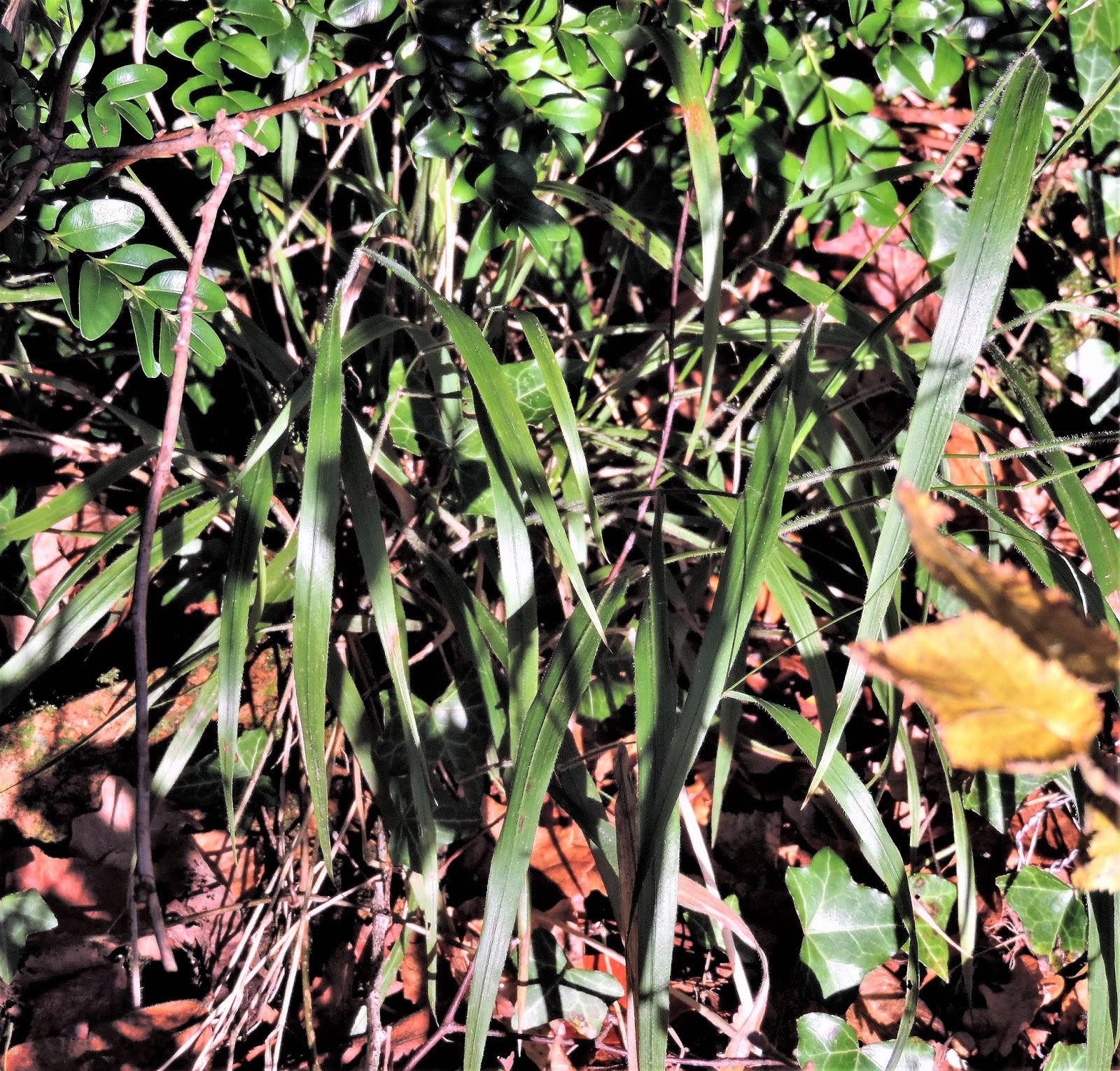
25 November 2017.  Now the colder weather has arrived (there was a grass frost this morning) there is less that catches the eye, but some of the evergreen plants come into their own.  The shining green curved blades of false-brome grass (Brachypodium sylvaticum), for example.  It is one of those plants that is an invasive alien in parts of North America, but seems perfectly well-behaved here.  It grows mainly in light woodland, or woodland edges in South East England and is well-established here on the north west corner of the square metre.


On the north east corner I place a block of freshly cut chestnut wood in January 2013 as a refuge (Gingerbread Refuge) for small creatures. After nearly five years it shows no sign of decay, nor has it been colonised by lower plants. Compare with the untreated mossy log in front of it.


On the south west of M3, I noticed that the base of the hornbeam has been covered by an attractive 'sock' of common feather-moss (Kindbergia praelonga), a very common species in woodlands and hedges on decaying trunks and living trees where it has the habit of climbing up from the ground.  After a burst of enthusiasm for mosses and liverworts around the turn of the century, I have rather neglected them and may try again over the winter.


Over in Medlar Wood, now a new glade due to the effects of the fallen incense cedar, I straightened up the small privet plant that has been establishing itself for at least five years.  It is our common wild privet, Ligustrum vulgare, and not to be confused with the hedging privet of gardens, L. japonica.  I have come across it occasionally in our area and we have some in the front hedge, but I do not think it is native here.  The slow-growing plant below was, no doubt, sown via the droppings of birds perching in the now vanished branches of the medlar.


18 November 2017.  Granddaughter Samantha borrowed a wood chipper yesterday and ground up lots of the fallen incense cedar to make pleasantly scented paths into M3.  I walked down today in November rain, but found very little that was new.  There is one red rose hip on the sweet briar and a black, grey and white magpie feather near Butterfly Rock.  Is that a bird to record?  A few winter gnats (Trichoceridae) ghosted slowly through the damp air.

15 November 2017.  Halfway up the main stem of the ash tree there is a fairly large lesion.  It may have been caused by the wild rose stalks rubbing against it, but lesions are also one of the symptoms of ash die back disease.  Will find out in due course.


By the old yew log I found a tiny toadstool - a Mycena I think.  At first I thought it might be M. rubromarginata, but it does not have red edges to its gills.  I shall leave it at that.


14 November 2017.  The gladdon irises, Iris foetidissima, are doing well this year and seem to be spreading in the wider area.  They brighten up the part of M3 I call Medlar Wood, though the medlar branches were broken by the fall if the incense cedar.  The irises like it here because the seeds were dropped by birds perching in this vanished part of the tree.  It will be interesting to see how this area develops with the advent of light.


13 November 2017.  Very cold again today with a biting northerly.  I looked at the fallen  leaves on M3 which seem to be more than usual.  I decided not to clear any away but to see what happens to them as time goes by.


At the top of the photo above is the base of  our oldest birch tree.  Since it was a seedling it must have displaced a fair amount of soil and I wondered where it had gone.  Compressed into a smaller space?  Creating a shallow hillock?  Pushed further down into the ground?  Distributed, in part along the roots, trunk, branches and leaves?

12 November 2017.  Clipped back some of the box on the northern side of M3 as it is beginning to encroach over the Metre itself.  Very cold so didn't stay long.  Noted one poorly developed toadstool Lactarius quietus I think,

11 November 2017.  I heard today on TV that England has been moving northwards on its continental plate by around 4 cm a year.  If this is correct it means that, over its 14 years, the Square Metre will have moved some 56 cm, just over half a metre (probably northwards).  I feel this gives the Square Metre two dimensions: that of a square of land on a moving continental plate and that of a congruent  square defined by its latitude and longitude.  Two squares with one moving, one stationary.  After 25 years there will be no overlap - I will have to bear this in mind.

10 November 2017.  I did the annual trim of the hornbeam, cutting it back to 1 metre in height and shortening side shoots to preserve its cylindrical shape.  I also topped out the oak at 1 metre.  There was a blue tit hopping about in the hedge and under the remains of the medlar.  It made a rather deep twittering sound more like a wren and I fancy there was a wren to in the background.  Although the cats only left last weekend, the birds seem to be coming back.


Thursday, November 09, 2017

A return to Emthree

It is nearly 14 months since I wrote about Emthree, the Square Metre Project, so it is high time I set down some new observations.  Access has been restricted lately due to a wind-thrown incense cedar, Calocedrus decurrens whose top narrowly missed Emthree itself but brought down much of the medlar tree blocking the route in and out.  The medlar branches have now been cleared and this has let more light back into the area.


Though the photo above looks a bit of a jumble it is (to me) full of interest.  The silver birch slightly left of centre appeared as a seedling 13 years ago in 2004.  There is a sallow, Salix cinerea, like a slanting grey stick immediately to the right and further right still a hornbeam, still in leaf, which has to be carefully pruned to keep it as a one meter high column.  Towards the top right hand corner is the top of a young oak tree and there is a holly at the base of the birch.  The leaves against the dark background top centre are of small-flowered sweet-briar, Rosa micrantha.

To the left of the birch is the slender grey trunk of an ash with hazel, still with leaves, at its base.  Although they cannot be easily seen, there are field rose, Rosa arvensis, and hawthorn, Crataegus monogyna, in the mix.  All these plants have appeared as seedlings of their own accord and I often reflect that if a piece of ground was characterised by its supporting naturally regenerated birch, sallow, hornbeam, oak, holly, ash, hazel and hawthorn, it would be thought of as woodland, possibly ancient.  It illustrates too that its often unnecessary if not undesirable and expensive to plant trees for woodland creation when they will come up of their own accord, though seedlings are harder to protect from nibblers than tree-guarded saplings (Emthree's trees have been regularly attacked by rabbits and deer but struggle on).

This new close encounter with Emthree also produced a couple of fungi: the orange yellow hairy curtain crust, Stereum hirsutum, growing on a dead twig and what I think is an oakbug milkcap, Lactarius quietus.  This species is associated with oak trees (note that there is one of these in Emthree) and the 'bug' part of the name is due to the fact that it is supposed to smell like bed bugs.  'Quietus' can mean, in English, 'something that causes death' or, in Latin, 'peaceful' or 'bland'.  This species is not described as poisonous and, if from Latin, the specific name may refer to its rather inconspicuous nature.  I also liked the description of the cap in Common British Fungi by Wakefield & Dennis (1950): "of a peculiar dull reddish-brown (somewhat like cocoa with milk)".


Thursday, September 15, 2016

13th anniversary

Today I made a maintenance visit to the Square Metre project, partly to celebrate the 13th anniversary of the project (which I have seriously neglected during the summer) partly just to tidy up a bit and restrain the brambles.  Most of the tree species have grown vigorously.  The large birch is now one of the tallest trees in the garden; the hornbeam has put on a good metre as has the oak.  The holly and the hazels are doing well and both will make feature items in this 'square metre wood' as it has now become.

Many of the birch leaves have fallen already, carpeting the ground with yellow brown making it quite unlike the grassy meadow it was in the past.  The oak has grown vigorously and many of the leaves have had their undersides totally grazed out by larvae of the oak sawfly (a Caliroa, annulipes I think).


There were no flowers out, but a splash of colour was provided by a few hips of small-flowered sweet briar, Rosa micrantha, identified when in flower during the summer.  I have nurtured it from when it was a seedling in 2004.  Another prickly customer doing well in the bramble hedge is shown below.


Saturday, May 21, 2016

Aphids and red campions

Some of the leading shoots of our red campions have developed colonies of chubby, shiny black aphids over the last few weeks. These are either Brachycaudus lychnidis or B. klugkisti, species that are difficult to separate.  Sometimes they cluster in the flowering tops of the plant (see right) and they also spread out across a leaf like a herd of grazing cows (see below).

These aphids appeared before any flowers had opened and were soon attended by egg-laing female hoverflies.of the Platycheirus scutatus group.  This includes several species some of which are little known and are difficult to separate in the female sex (though I might have a go in due course).


As well as red campions, the sweet vernal grass has started to flower.  The plants now cling to the southern edge of the study area where there is plenty of light. (The rear of the area is now very shady and has a woodland character).


High above the ground (2 metres) and poised above Emthree I spotted a snail in a cross-roads between a spiny wild rose and a crucifix-shaped piece of ash wood.  It seems to me there is symbolism in this so close to Easter, but I leave my visitors to work out what this might be.


Sunday, May 08, 2016

Speeding up

The pace of events is quickening now and the last two days have been very warm.  However, it seems to me there are nowhere near as many flying insects about as in previous years.

Not long ago I moved the bench I sit on from time to time from the east of the Square Matre to the south, but something did not like it as two nights running I found it tipped over - deer, badgers, cats: a mystery.  Anyway, I gave up putting it back in place and now sit on a rather plasticky kneeler which is actually more comfortable and allows me to haul my old bones up and down more easily.


The birch tree is performing well this year and has many male catkins that fall and drape themselves over Emthree plants.  The female catkins are shorter and more stubby and do not fall from the higher branches like the males.


The hornbeam, kept to 1 metre tall, is now well into leaf and I notice that the buds at the top of the plant open two or three weeks later than those lower down.  This must be because the lower buds formed in the autumn, but the upper, adventitious buds have had to wait for in the spring.


Thursday, April 28, 2016

Icy spring


We are having a long spell of cold weather, much worse than most springs.  The day before yesterday in snowed on and off during the afternoon, and yesterday we had a hail storm in the early evening that whitened the ground.


The two pictures  above are of the eastern side of Emthree with a red campion plant adorned with melting hail stones.  I don't think this passing storm has done any appreciable damage, except possibly bruising some young leaves.  Below a hailstone and a skin of melting ice on birch.


Thursday, April 14, 2016

Fast fern

Yesterday I measured, with my walking stick, a rising frond of broad buckler fern (Dryopteris dilatata) almost in the centre of Emthree.  Checking again today I found in had grown 5cm (2 inches) in 24 hours illustrating how quickly spring advances in the present warm weather (in the last 2 days it has reached 20 degrees C).  In the picture (right) of the stem of the frond towards the bottom left hand corner shows the dark-centred scales that are characteristic of this species.

There is now an increasing amount to enjoy.  A male brimstone, or maybe the male brimstone, circled flashily around Emthree, a small queen wasp examined the bark of the birch probably looking for nest material and I thought of impending tasks.  I have started hand grazing some of the longer grass and trimming back marauding brambles: one had extended an arc of cane from the bramble hedge almost to the Square Metre and taken root in the penumbra area.  I must tie up the wild roses, clear some of the moss from the stones and designate the area where the young hazels grow to short term rotation coppice.  When they have grown one metre tall I will cut them back close to the base, perhaps one one year and the other another.

There are more insects now: a few fast solitary bees, some glittering carabid beetles often taking briefly to the wing, a dock bug labouring ponderously up the stem of the largest ash, then taking flight to expose its smoky red abdomen as, maybe, a protective device.

In the wilderness area to the south of the medlar tree I found what could be one of its seedlings or suckers.  This will hopefully one day replace the existing tree that is dying of fungal attack.  There is also a plant of what looks like hoary willowherb (Epilobium parviflorum) nearby whose identity I will have to check when it flowers.  It will be a\new record for the area (or slightly beyond it)

Monday, April 11, 2016

A new log

The long log across the centre of Emthree (east/west) has once again returned to the earth and I have replaced it with a new one of oak or, maybe, chestnut found in the nearby wood.  This could have a longer life.  The trees at the top of the picture include the sallow on the left, the birch and the ash at the end of the log and most of the rest of the Square Metre fits into the frame with the western boundary marked by the ash tree.


While positioning it I had an amusing accident.  I sat on the little bench I use to admire my handiwork and it toppled over backwards in slow motion, depositing me in the mass of brambles and nettles that lay behind.  I could not get up too easily from this position as my legs were arched over the now vertical bench seat and I could not get enough purchase on anything to win sufficient leverage, so I lay there for a few moments enjoying the blue sky through a filigree of birch twigs. After a bit I managed to worm sideways, get on to my hands and knees and re-assume the vertical apparently uninjured apart from a few scratches.

Another highlight of the day was the discovery of a hawthorn seedling (see right) close to the centre of the metre square.  It must have been a small plant through 2015 and now seems to be enjoying its second year.

Sunday, April 10, 2016

Bees and birch trunks

In sunny weather flies and other insects settle on the white bark of the large birch tree to warm themselves up.


The picture is of a male small sallow mining bee, Andrena praecox, one of the many insects attracted, no doubt, to the pollen of our large male goat willow, Salix caprea, in full bloom nearby..

The trunk of the birch sheds horizontal strips and patches of the thinnest bark and these flutter ceaselessly in the wind while still attached making it harder perhaps for predators to see the dark insects against the ever-shifting patterns of light and shade created by these shifting shreds.

Friday, April 08, 2016

Mustard oak

Enough midday sun to warm the shoulders and a feeling of freshness, almost of joy in the air that can only be experienced in spring.  The birds and animals feel it too.  A great spotted woodpecker was drumming noisily, a hollow ‘ratatatat', a few metres away in Churchland Wood.  A couple of dock bugs, Coreus marginatus, (see left) were skittering about in the meadow area on the south side of Emthree; a bee fly made a sortie across the Square and the oak tree over the hedge has suddenly burst into leaf.  This new growth is a striking mustard yellow colour and only lasts a few days before the green creeps in.  The small Emthree oak has expanding buds, but not as advanced, though the larger tree may well be its parent.


I had a further look at the base of the collapsing bramble hedge, a damp, mouldering undercroft characterised by the dingy green webs of common feather-moss, Kindbergia praelonga. Other plants already here included stinging nettle, various ferns and grasses, red campion, cleavers, creeping buttercup, herb-robert and bugle. The friable wet dead wood gives it the quality of a small nightmare creeping along a corridor of thorn-guarded shadows.


One brighter aspect of this sinister grot was a surviving leaf of bramble intricately mined by larvae of the tiny glossy bramble pigmy moth Stigmella splendidissimella.  The mines were empty, but maybe a new generation of moths will soon be emerging.